PyTorch Without the Calculus: What It Is and What You Can Ignore
A gentle, math-free introduction to PyTorch for engineers and technical PMs — what it actually is, what you can safely skip, and how to set up Google Colab to run real AI models.
Tensors, shapes, the GPU, and building your first model from a single layer up — the math-free groundwork, in Colab.
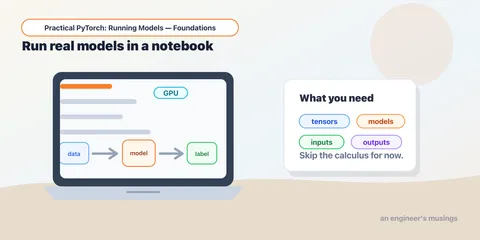
A gentle, math-free introduction to PyTorch for engineers and technical PMs — what it actually is, what you can safely skip, and how to set up Google Colab to run real AI models.
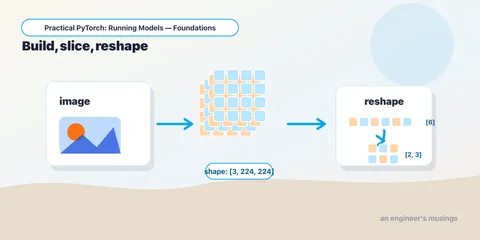
A beginner-friendly tour of pytorch tensors — creating them, indexing and reshaping them, and doing arithmetic on them — with no linear-algebra homework attached.
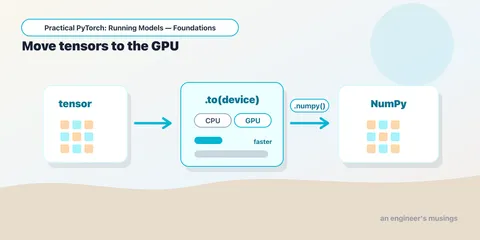
A beginner-friendly guide to moving PyTorch tensors between the CPU and GPU with .to(device), trading data with NumPy, and pulling a single value out with .item() — no math required.
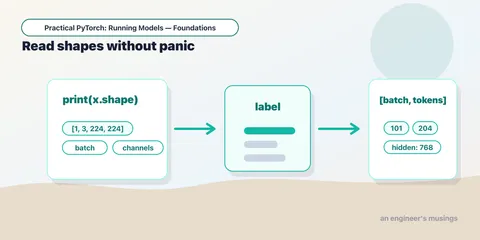
A practical PyTorch shape-reading guide for beginners: batches, image tensors, classifier outputs, token IDs, hidden states, and the print-shape habit that makes model code debuggable.
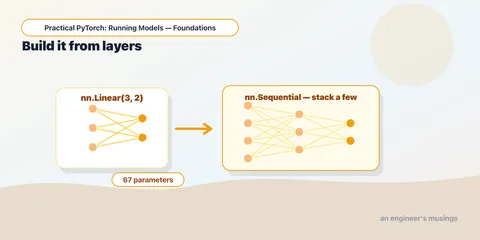
A gentle, math-free look at what a neural network is actually made of — layers and parameters — by building one yourself in PyTorch, from a single nn.Linear up to a small stack, and reading its insides. Beginner-friendly.
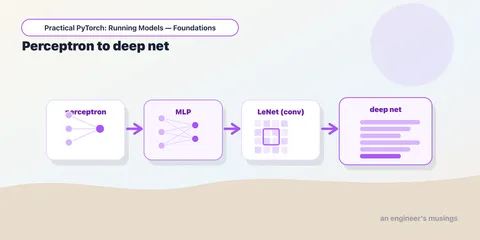
A gentle, math-free tour of the models your toy network descends from — the perceptron, linear and logistic regression, the multi-layer perceptron that cracked XOR, and LeNet, the first famous CNN — built in a few lines of PyTorch.
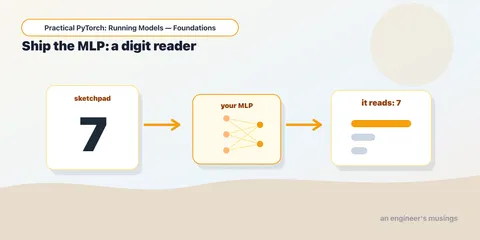
Your first capstone: take the MLP you built by hand, load trained weights into it, and wrap it in a Gradio app that reads handwritten digits you draw — a real, shareable tool, no training required.