Audio Is a Tensor Too: Waveforms, Sample Rate, and Spectrograms
A beginner-friendly intro to audio in PyTorch — load a waveform with torchaudio, read its shape and sample rate, and turn it into a mel spectrogram, the image a model actually sees.
Generate speech and music with pretrained models — text-to-speech, neural audio codecs, and MusicGen — in Colab, still without the math.
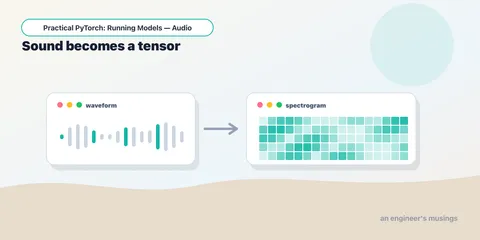
A beginner-friendly intro to audio in PyTorch — load a waveform with torchaudio, read its shape and sample rate, and turn it into a mel spectrogram, the image a model actually sees.
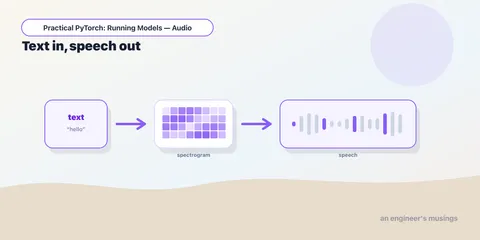
Run your first text-to-speech model in Colab with SpeechT5 — text in, speech out, on CPU — and learn the encoder, mel spectrogram, and vocoder pieces behind it.
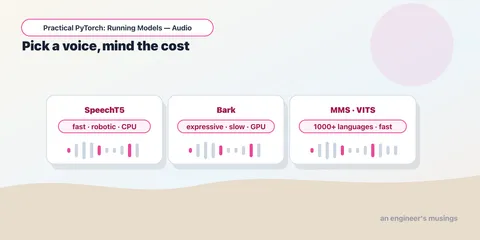
Run two more open text-to-speech models in Colab — Bark for expressive, human-sounding voices and Meta's MMS-TTS/VITS for 1000+ languages — and learn to pick a TTS model by its trade-offs.
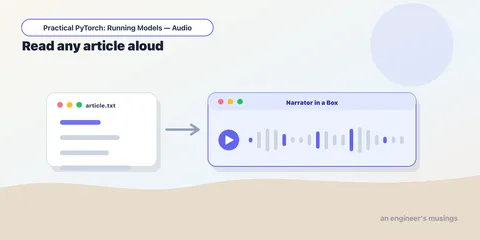
Build a text-to-speech app that narrates a whole article — split sentences, synthesize each with SpeechT5, stitch the clips, and wrap it in a Gradio UI.
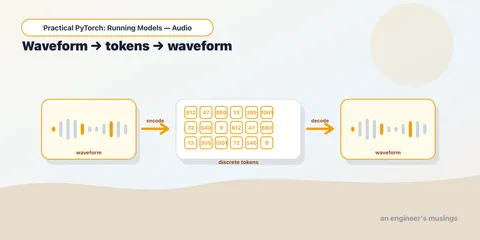
A beginner-friendly look at neural audio codecs in PyTorch — use Encodec to turn a waveform into discrete tokens and back, the trick that lets a transformer generate sound.
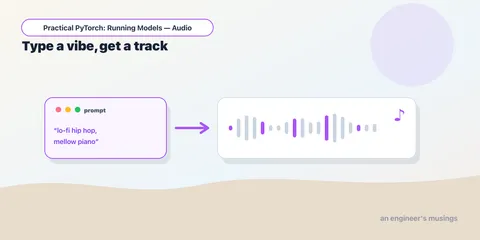
Generate music from a text prompt in Colab with MusicGen — the easy pipeline way and the honest processor-plus-generate way — and see how max_new_tokens sets the clip length.
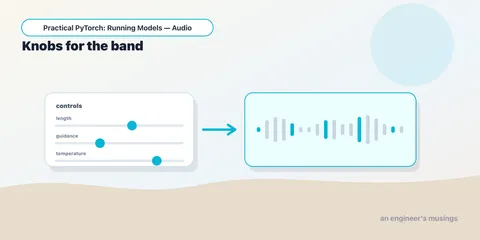
Take control of MusicGen in PyTorch — set clip length with max_new_tokens, tune do_sample, temperature, and guidance_scale, batch multiple prompts, and condition on a melody with musicgen-melody.
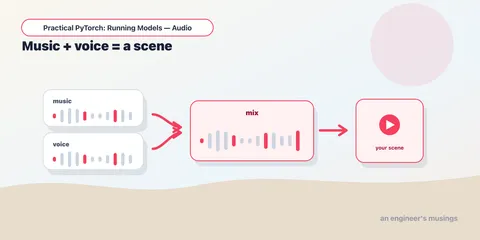
The series finale — generate a music bed with MusicGen and a narration line with SpeechT5, resample to a common rate, mix and normalize them into one clip, and wrap it in a Gradio app.