DataWeave Is a Language, Not a Field-Dragging Widget
The mindset shift that makes DataWeave click — it's a functional expression language with a data model, not a drag-the-fields mapper. Meet the script anatomy and your first transform.
DataWeave 2.0 as a functional language — the data model, types, functions, and the map/filter/reduce core that transforms behave.
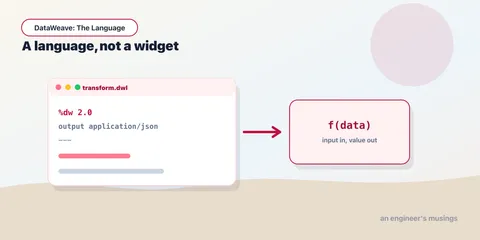
The mindset shift that makes DataWeave click — it's a functional expression language with a data model, not a drag-the-fields mapper. Meet the script anatomy and your first transform.
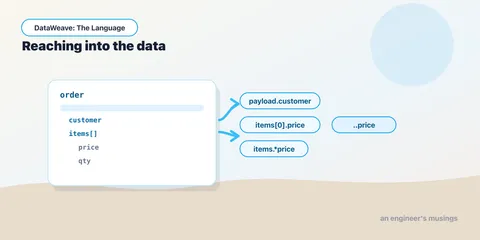
Selectors are how DataWeave navigates the data model — keys, indexes, ranges, multi-value and descendant selectors, and the null-safe rules that trip up newcomers coming from other languages.
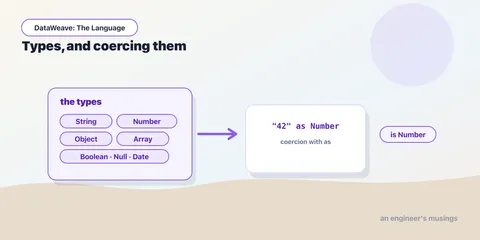
DataWeave has a real type system — a clean hierarchy, coercion with `as`, format schemas that parse and print dates and numbers, and custom, union, and literal types you define yourself.
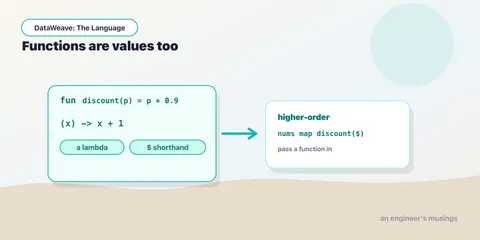
Named functions, lambdas, and the positional shorthands — how first-class functions turn DataWeave from a mapper into a language you can compose.
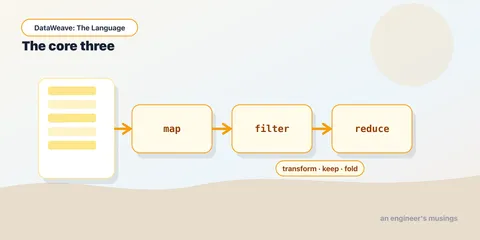
The three functions you'll use in every transform, taught properly — including the accumulator, the seed, and what reduce does to an empty array.
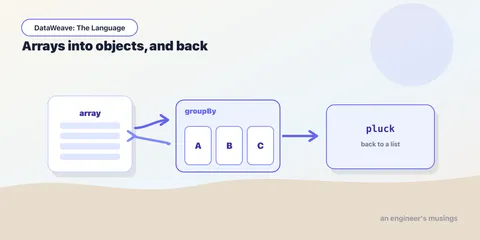
groupBy, pluck, mapObject, distinctBy, orderBy, and flatMap — the DataWeave functions that turn one shape into another, plus dynamic and conditional keys.
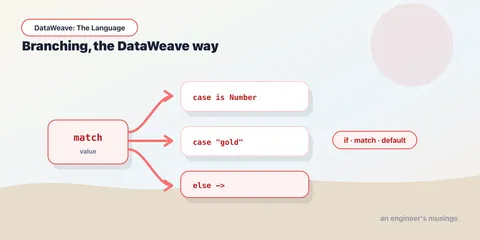
Conditionals the DataWeave way — if/else expressions, match/case with value, type, and regex patterns, the default operator, and the do scope for readable branching.
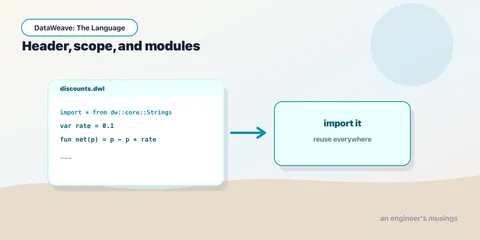
The last of the language: multiple vars and funs in the header, the do scope for locals, importing the standard library, and factoring your own reusable .dwl module.