Loops: The Lazy Way to Draw
Why type the same lines over and over? Meet the loop — Python's way to repeat — and draw any shape in just two lines instead of a dozen.
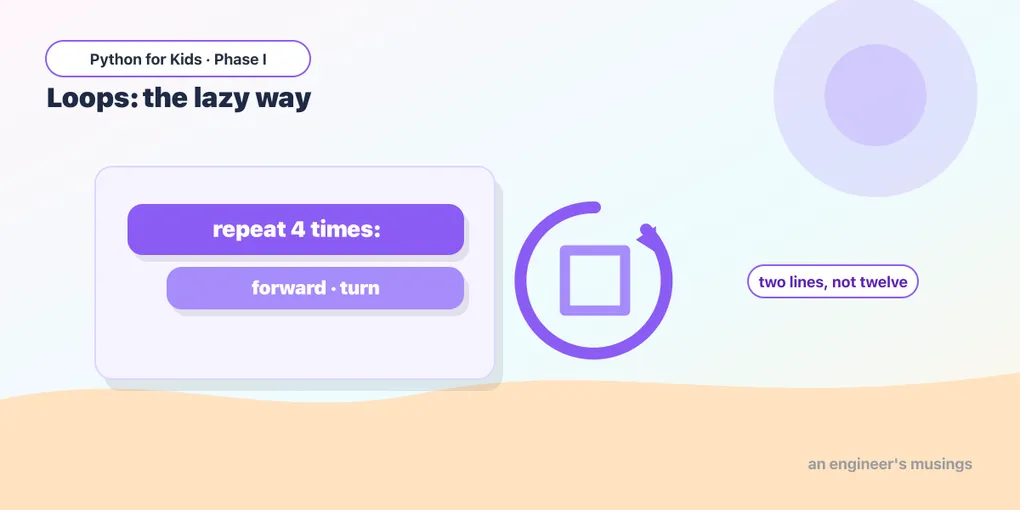
Welcome to Week 2! Last week, drawing a hexagon meant typing forward and right six times each — twelve lines for one shape. Good programmers hate repeating themselves. Today you learn the single most useful idea in all of programming: the loop.
Tell Python to repeat
A loop says “do this, a bunch of times.” Here’s the shape of it:
for step in range(4):
    # the indented lines happen 4 times
Two things to notice:
range(4)means do it 4 times.- The repeated lines are indented (pushed in). The indentation is how Python knows what’s “inside” the loop.
Here’s a whole square. The two lines you used to repeat are now written once, inside a loop:
Same square. The dozen lines became two. That’s the magic: write it once, tell Python how many times.
Try it 🎯
- Change
range(4)torange(3)andright(90)toright(120). A triangle! - Change to
range(5)andright(72). A pentagon! - Change
forward(100)toforward(160). Bigger.
The shape rule, now with loops
Remember the rule from Lesson 2? Turn = 360 ÷ number of sides. A loop makes it effortless — you only change two numbers: the count in range(...) and the turn.
| Shape | range | turn |
|---|---|---|
| Triangle | 3 | 120 |
| Square | 4 | 90 |
| Pentagon | 5 | 72 |
| Hexagon | 6 | 60 |
| Octagon | 8 | 45 |
Your turn 🎯
Make a hexagon (6 sides). Change the range number and the turn to match the table:
Predict it 🔮
Using the table: what shape does range(8) with right(45) make? Guess first, then Run:
(An octagon — 8 sides, like a stop sign.)
Fix the bug 🐞
This loop is supposed to draw a triangle, but it makes a weird open shape. The range is right for a triangle, but the turn is wrong. Fix it using the rule:
(Three sides need a turn of 360 ÷ 3 = 120. Change right(90) to right(120).)
Sneaking up on a circle
What if you use lots of sides with tiny turns? Try 36 little steps, turning just 10 each:
Almost a perfect circle! A circle is really just a shape with so many tiny sides you can’t see the corners. (36 turns of 10 = 360, a full spin.)
Mix it up 🎨
In the near-circle above, try range(60) with t.right(6) (even smoother), or range(18) with t.right(20) (chunkier). What’s the smallest number of sides that still looks round to you?
Your mission 🚀
Draw a many-sided shape of your choice — anything from a triangle to a 12-sided shape. Pick your number of sides, use the rule (360 ÷ sides) for the turn, and set it up in a loop:
What you learned today
- A
for ... in range(n):loop repeats the indented linesntimes. - Indentation marks what’s inside the loop.
- Any equal-sided shape: count in
range, turn = 360 ÷ sides. - Many tiny sides make a circle.
Loops don’t just save typing — they make brand-new things possible. Next time you’ll spin loops into spirals, stars, and flower-like patterns that would be almost impossible to type by hand. 🐢
Comments