True or False: Asking Yes/No Questions
Before a computer can make decisions, it has to answer yes/no questions. Meet True and False, the comparison signs, and the words and, or, and not.
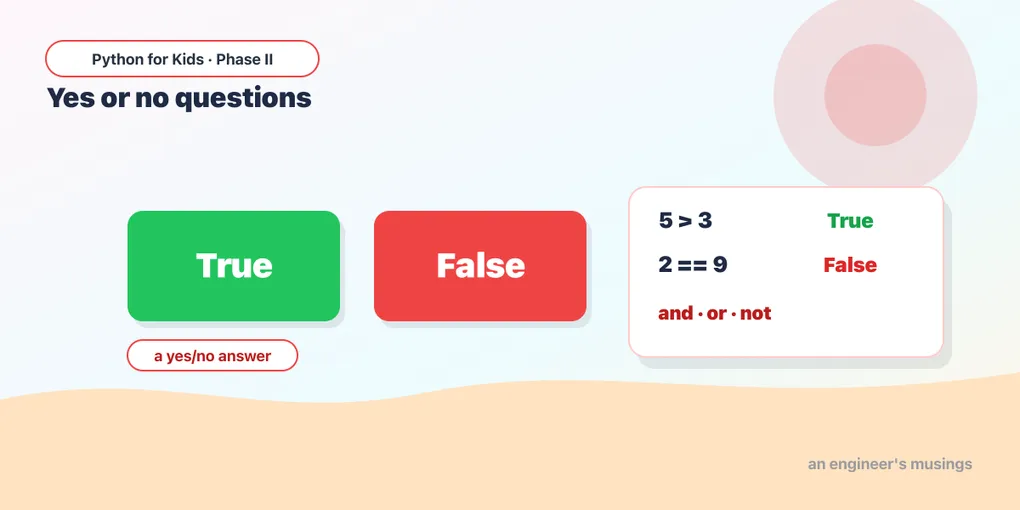
To make decisions (next lesson), a computer first has to answer yes/no questions: Is this bigger than that? Are these equal? Python has a special pair of values for the answers: True and False. They’re called booleans, and today you’ll learn to make them.
Comparisons make True or False
Ask Python to compare two things and it answers True or False:
| Sign | Means |
|---|---|
== | is equal to |
!= | is not equal to |
> | greater than |
< | less than |
>= | greater than or equal |
<= | less than or equal |
That double equals == is important: a single = stores a value (age = 12), while double == asks “are these equal?” Mixing them up is a classic bug.
Try it 🎯
- Print whether
100is less than or equal to100. - Make a variable
age = 12and printage >= 13(are they a teenager?).
Comparing words too
Comparisons work on strings — handy for checking answers:
Combining questions: and, or, not
Real questions often have parts. Python uses plain words:
and— True only if both sides are True.or— True if either side is True.not— flips True to False and back.
The first asks “is the age between 12 and 20?” Both parts are True, so the answer is True.
Try it 🎯
A ride needs you to be at least 10 and no taller than 200cm. With age = 11 and height = 150, write the check: age >= 10 and height <= 200.
Predict it 🔮
What does this print? Watch the single vs double equals. (Hint: one of these lines is a question, the answer is True/False.)
(It prints True. The == asks a question; x really is 8, so the answer is True.)
Fix the bug 🐞
This should check whether the user guessed the secret number 7, but it crashes with a syntax error. Look at the equals sign in the comparison:
(A comparison needs double equals. Change guess = secret to guess == secret.)
Your mission 🚀
Ask the user for a number, then print True or False for whether it’s a “big” number — say, greater than 100:
What you learned today
TrueandFalseare booleans — the computer’s yes/no answers.- Comparisons (
==,!=,>,<,>=,<=) produce booleans. =stores;==asks. Don’t mix them up!and,or,notcombine yes/no questions.
Next time, you put these to work: if lets your program do different things depending on whether a question is True. 🔀
Comments