Working with Words
Strings are the computer's words. Glue them together, measure them, make them LOUD or quiet, and repeat them — the start of real text programs.
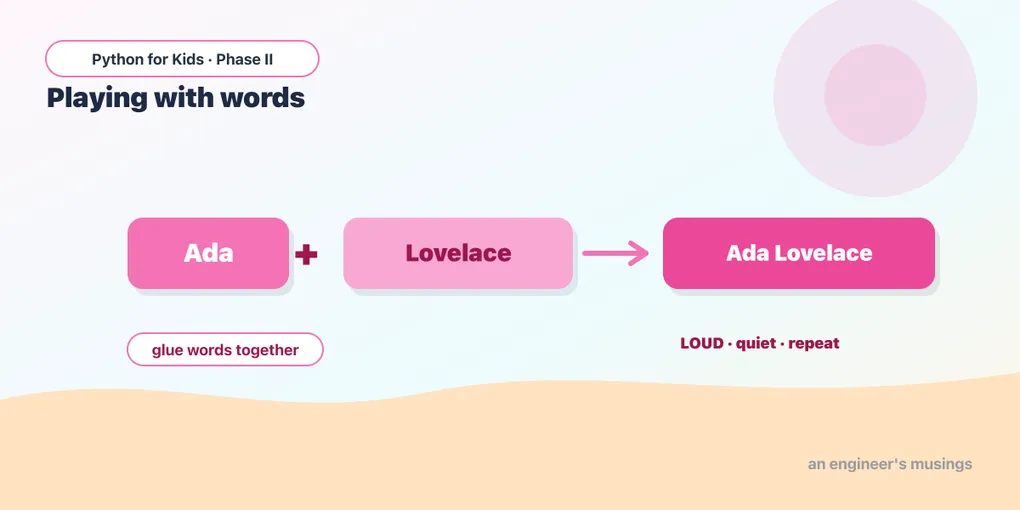
Last time you printed words and stored them in variables. Today you learn to do things to words. In Python, a piece of text is called a string, and strings come with a bunch of handy tricks.
Gluing words together
The + sign joins two strings into one. This is called concatenation (fancy word, simple idea — stick them together):
Notice the " " in the middle — that’s a string with just a space, so the name doesn’t come out as AdaLovelace. You have to add spaces yourself.
Try it 🎯
- Put your own first and last name in.
- Build the name backwards:
last + ", " + first(like a class list).
Measuring a word
len(word) tells you how many characters are in a string:
Try it 🎯
Ask the user for a word with input, then tell them how long it is.
LOUD and quiet
Strings have built-in methods — little commands you attach with a dot:
.upper()makes it ALL CAPS..lower()makes it all lowercase.
A .method() doesn’t change the original string — it hands back a new one. That’s why we print the result.
Repeating a string
Multiplying a string by a number repeats it. Great for drawing lines of text or being dramatic:
Try it 🎯
Make a “fence” by printing "|--" repeated 10 times.
Putting it together: a shout machine
Ask for a word and shout it back, with excitement:
Predict it 🔮
What does this print? Think about what + does with two strings. (Hint: it does not do math here.)
(It prints 34, not 7! When both sides are strings, + glues them. Those are the characters 3 and 4, not the numbers. Doing actual math is next lesson.)
Fix the bug 🐞
This is supposed to print Hello, friend but the words are jammed together. Add the missing space:
(Glue a space in: greeting + " " + who — or use a comma in print, which adds the space for you.)
Your mission 🚀
Write a “name styler”: ask the user for their name, then print it three ways — all caps, all lowercase, and repeated three times:
What you learned today
- A string is text;
+glues strings together (remember the spaces!). len(word)counts characters..upper()and.lower()change the case (and hand back a new string)."abc" * 3repeats a string.
Next time: numbers and math — and the important difference between the text "3" and the number 3. 🔢
Comments