How a Model Learns: Being Wrong, On Purpose, A Million Times
A math-free, beginner-friendly walkthrough of how neural networks learn — the training intuition behind loss, gradients, optimizers, and epochs, with no calculus required.
Understanding & fine-tuning — how models learn, and adapting a pretrained model to your own data, still without the heavy math.
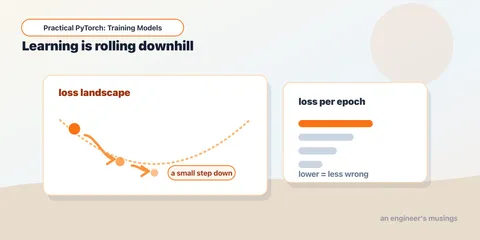
A math-free, beginner-friendly walkthrough of how neural networks learn — the training intuition behind loss, gradients, optimizers, and epochs, with no calculus required.
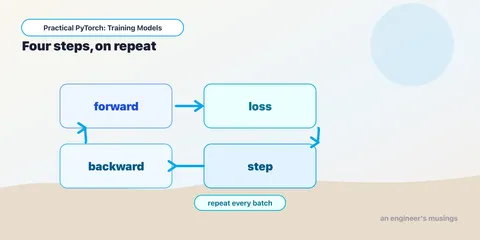
A beginner-friendly walk through the PyTorch training loop — forward, loss, backward, optimizer step — and what loss.backward() and optimizer.step() actually do.
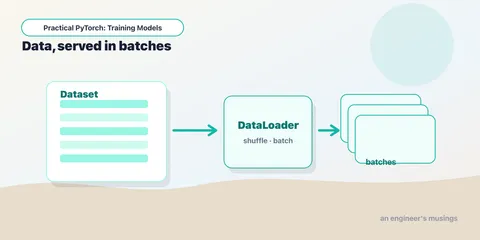
A beginner-friendly guide to the PyTorch Dataset and DataLoader — how batching data and shuffling feed your training loop the right way, with a tiny custom example.
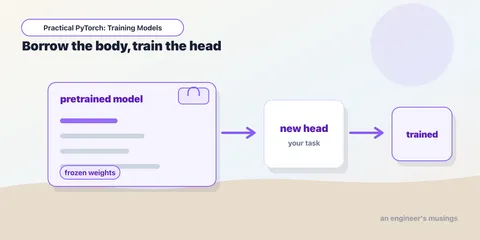
A beginner-friendly guide to transfer learning in PyTorch — fine-tune a pretrained model by swapping its head and freezing the backbone, no training-from-scratch required.
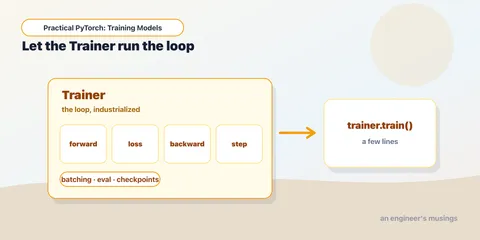
A beginner-friendly walkthrough of huggingface Trainer fine-tuning — fine-tune a text classifier on a real dataset end to end, with the hand-written training loop done for you.
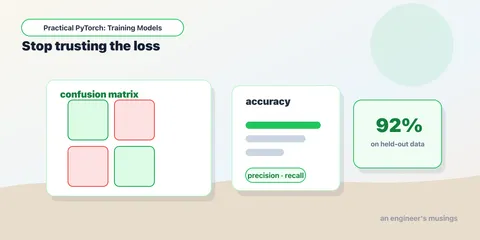
A beginner-friendly guide to evaluating a machine learning model — train/validation/test splits, accuracy, precision/recall and F1, and spotting overfitting before it fools you.
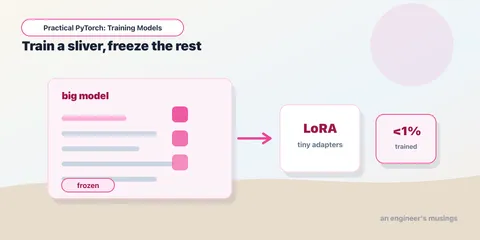
A beginner-friendly guide to LoRA fine-tuning and PEFT (parameter-efficient fine-tuning) — freeze the big model, train tiny adapters, and ship megabytes instead of gigabytes.
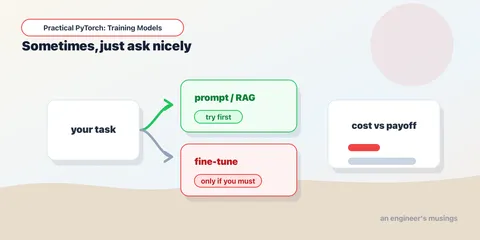
A beginner-friendly guide to when to fine-tune vs prompting vs RAG — why fine-tuning is usually the wrong first move, and the faster, cheaper options to reach for before it.
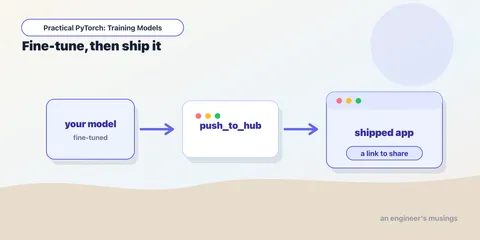
A beginner-friendly capstone — fine-tune a text classifier with the Trainer, then push to Hugging Face Hub and load it straight back to prove it's a real, shareable model.