Stop Building Bridges, Start Building Layers
API-led connectivity is the architecture MuleSoft keeps evangelizing. Here's what System, Process, and Experience APIs actually buy you — and why the layering is the point.
You finished the foundations series. You can build a flow, transform a payload with DataWeave, call a downstream API, handle errors, and ship the thing to CloudHub. That’s enough to be dangerous — enough to wire System A to System B and call it done.
Do that a dozen times and you rebuild the exact problem MuleSoft exists to solve. Every integration is a fresh bridge between two specific endpoints, each one hand-carved, none of them reusable. This series is about the discipline that keeps that from happening, and it starts with an architecture: API-led connectivity.
The mess we’re avoiding
Point-to-point integration is seductive because the first one is cheap. Mobile team needs order data, so you build a flow that reads the orders database and returns JSON shaped exactly for the mobile app. It works. Everyone’s happy.
Then the web team needs order data too — but shaped differently. So you build a second flow to the same database. Then the partner portal needs it, shaped a third way. Then someone migrates orders from a legacy DB to a new microservice, and now you’re editing three flows that each embedded the old schema. The bridges don’t share pilings. Each one knows too much about both ends, so a change on either side ripples through all of them.
API-led connectivity breaks that by inserting layers between the raw system and the consumer — each layer a reusable API with a clear job.
Three layers, three jobs
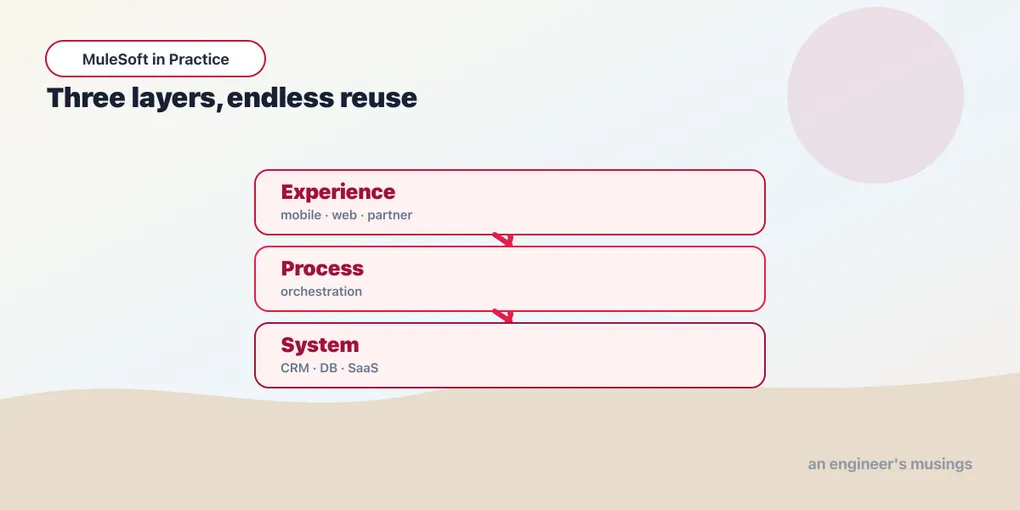
The model has three tiers, and the discipline is refusing to let responsibilities leak between them.
System APIs unlock a backend and hide how it works. One System API in front of the orders database, one in front of Salesforce, one in front of the SAP box. It speaks the backend’s language on one side and a clean, stable REST contract on the other. When orders migrate from that legacy DB to a microservice, you rewrite the System API’s insides and nothing above it notices — the contract held. That insulation is the whole reason the layer exists.
Process APIs orchestrate. They compose several System APIs into a business capability that no single backend owns. “Fulfill an order” isn’t a table — it’s a customer lookup, an inventory check, a payment authorization, and a shipping call, stitched into one operation with its own logic. A Process API holds that choreography. It talks only to System APIs (and other Process APIs), never straight to a database.
Experience APIs tailor. The same underlying capability gets reshaped for whoever’s consuming it — a lean payload for a phone on a slow network, a richer one for the web, a locked-down one for a partner. An Experience API is a thin adapter over Process and System APIs; its job is the last mile of formatting, filtering, and field-renaming, not business logic.
Read from the bottom up, each layer only knows about the layer directly beneath it. That’s not bureaucracy for its own sake; it’s what makes the pieces swappable.
A worked example: order status
Say a mobile app wants to show “where’s my order.” Point-to-point, you’d query the orders DB and the shipping system and mash the results together in one flow bolted to the phone’s screen. Change the screen, edit the integration.
Layered, it decomposes:
- A Customers System API —
GET /customers/{id}over the CRM. - An Orders System API —
GET /orders/{id}over the order database. - A Shipping System API —
GET /shipments/{orderId}over the carrier’s service. - An Order Status Process API —
GET /order-status/{orderId}that calls the Orders and Shipping System APIs, merges them, and adds the “estimated delivery” logic that belongs to no single backend. - An Order Status Experience API —
GET /mobile/order-status/{orderId}that calls the Process API and returns a trimmed payload the app renders directly.
The Experience API is barely more than a flow reference and a transform:
<flow name="get-mobile-order-status">
    <http:listener config-ref="mobile-api" path="/order-status/{orderId}"/>
    <http:request config-ref="order-status-process-api"
                  method="GET"
                  path="/order-status/#[attributes.uriParams.orderId]"/>
    <ee:transform>
        <ee:message>
            <ee:set-payload resource="mobile-order-status.dwl"/>
        </ee:message>
    </ee:transform>
</flow>
That’s the shape of an Experience API: listen, delegate to a Process API, reshape, return. No database credentials, no join logic, no idea what a shipment record looks like. When the web team shows up wanting the same data, they build their own Experience API against the same Process API — and the Process API doesn’t change at all.
Why the layering pays off
Reuse is the headline, but it’s the second-order effects that make this worth the extra hops.
Decoupling. A backend migration stops at the System API. A new consumer channel stops at a new Experience API. Change is contained to one tier instead of rippling across every integration that touched the data.
Parallel teams. Because the contracts are the boundary, the CRM team can own the Customers System API while the mobile team owns their Experience API, and they only have to agree on the API definition — not on each other’s internals. That’s exactly why the next post is about designing that contract first.
Governance. Every layer is an API, so every layer is a place to apply policy — rate limits, client-ID enforcement, OAuth — at the gateway instead of in application code. We’ll spend two posts on that later. Point-to-point flows have nowhere to hang policy; a layered API estate has a natural seam for it.
The cost is real: more moving parts, more network hops, more APIs to deploy and version. For a genuinely one-off, throwaway integration, three layers is overkill and you should just build the flow. The layering earns its keep when data gets reused, backends change, and more than one team is in the picture — which, in an enterprise, is always.
Final thoughts
API-led connectivity isn’t a MuleSoft feature you switch on. It’s a way of drawing lines — deciding what each API is allowed to know — and then holding those lines when the deadline pressure says “just query the database from the Experience API, it’s faster.” The moment you let that leak, you’re back to bridges.
Everything else in this series sits on this frame. Design-first contracts, batch jobs, reliability queues, gateway policies, OAuth, caching, CI/CD — each of them makes more sense once you see the estate as layers of reusable APIs rather than a pile of point-to-point flows. Start with the layers, and the rest has somewhere to live.
Next: designing the API first with RAML — because a reusable API is only as good as the contract you agree on before writing a line of flow.
Comments