Guardrails, Hooks, and Keeping the Keys Safe
Layered guardrails and secure-by-design defaults, hooks as the deterministic enforcement point for destructive actions, and managing secrets and API keys across development and production — least privilege, no keys in code, and identity you verify.
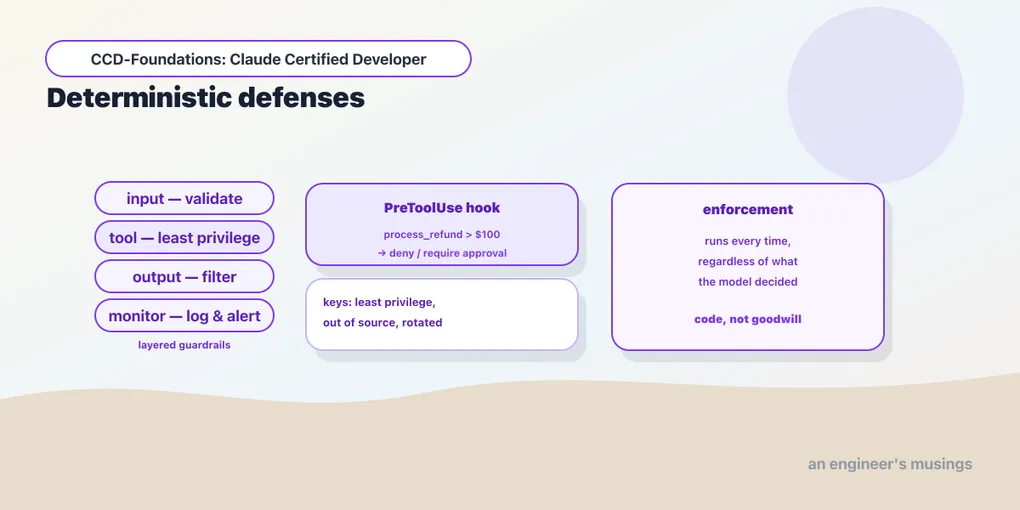
Chapter 18 ended on an uncomfortable truth: you can’t trust a probabilistic model as a security boundary. So where does the trust go? Into layers. Defense in depth is the whole idea here. No single check catches everything, so you stack several independent ones, each positioned to catch what the layer before it missed, and none depending on the model’s goodwill. An injection that slips past your input check still meets a least-privilege tool set; a bad output the model generates still meets an output filter. This chapter is those trustworthy layers. First, guardrails and the hooks that enforce them deterministically. Then the secret-and-key hygiene that keeps the whole stack from being undone by one leaked credential. It’s the deterministic half of security, where the PreToolUse hook does real work.
Guardrails, layered
A guardrail is a check that constrains what the system can do. The exam’s framing is guardrail layering: defense in depth, because no single check catches everything. The layers around a Claude application:
- Input guardrails — validate and sanitize before the model sees it: enforce the untrusted-data boundary (chapter 18), reject over-long or malformed input, screen for known-bad patterns.
- Tool guardrails — gate what the model can do: least-privilege tool sets, and approval or hook checks on consequential calls. This is the highest-value layer because it constrains actions, not just words.
- Output guardrails — check what the model produces before it reaches a user or a downstream system: content policy checks, PII redaction, schema validation (chapter 17).
- Monitoring — observe behavior in production: log tool calls, flag anomalies, alert on refused-and-retried patterns.
The point of layering is that each catches what the others miss. An injection that slips past the input layer still hits the least-privilege tool layer; a bad output that the model generates is still caught by the output filter. Secure-by-design means these aren’t bolted on after an incident. They’re the default posture: privacy by default, identity and access management from the start, and least privilege everywhere. Least privilege is the recurring principle: grant the minimum access any component needs.
Hooks: where a guardrail becomes deterministic
Guardrails are only as good as their enforcement, and a prompt-level “please don’t” is not enforcement. Hooks are where a guardrail becomes code that runs every time, regardless of what the model decided. The blueprint names them specifically: “leveraging hooks for guardrails and safety controls to prevent destructive actions.”
The mechanism: a PreToolUse hook, registered with a HookMatcher on a tool, fires before that tool runs and can deny the call. A hook matched on the Write tool fires when the model attempts a write and returns a deny decision that blocks it. That is a guardrail with teeth — the model wanted to act, and deterministic code refused.
The pattern for destructive actions:
# minimal decision helpers (real hooks return the SDK's permission-decision dict)
def deny(reason):             return {"decision": "deny", "reason": reason}
def require_approval(reason):  return {"decision": "ask", "reason": reason}
def allow():                   return {}

# a hook that blocks deletes and requires approval for large refunds
async def guard(input_data, tool_use_id, context):
    tool, args = input_data["tool_name"], input_data.get("tool_input", {})
    if tool == "delete_record":
        return deny("deletes are not permitted from the agent")
    if tool == "process_refund" and args.get("amount", 0) > 100:
        return require_approval("refunds over $100 need a human")
    return allow()
The rule: anything irreversible or high-impact passes through a hook, so the decision to actually execute it is made by your code, not the model’s reasoning. Hooks turn “the agent shouldn’t delete things” from a hope into a guarantee. (Hooks are also a construction primitive, chapter 8; here they’re the enforcement primitive for security.)
Secrets and key management
All of the above is undone by a leaked API key, so secret hygiene is its own Domain 7 skill. The essentials, and this book practices them:
- Never hard-code secrets. API keys, database credentials, and tokens come from environment variables or a secrets manager, never from source. The SDK reads
ANTHROPIC_API_KEYfrom the environment precisely so you don’t paste it in code. MCP server configs reference env vars for the same reason (chapter 11). - Never commit them. Keep secrets in files outside version control (a
.envthat’s git-ignored, or a secrets manager). This series’ own keys — the Anthropic key and the AWS credentials for the Bedrock chapter — live in a file outside the repo for exactly this reason. - Least privilege on keys. A credential should grant the minimum it needs. The AWS key used for this book’s Bedrock verification was scoped by an IAM policy to invoke Anthropic models only — no data access, no management. A leaked least-privilege key is a contained incident; a leaked admin key is a catastrophe.
- Rotate, and separate by environment. Development and production use different keys, so a leaked dev key can’t touch production, and keys rotate on a schedule and immediately on suspected exposure.
- Verify identity, and monitor access. Authenticate who is calling, check their access level before privileged operations (the code-side authorization of chapter 18), and monitor for anomalous use — a key suddenly making 100× its normal volume is a signal.
The through-line: a key is a liability as much as a credential. Scope it tightly, keep it out of code and version control, rotate it, and watch it.
Final thoughts
The trustworthy half of security is deterministic. Layer your guardrails — input, tool, output, monitoring — so each catches what the others miss. Make secure-by-design and least privilege the default rather than the patch. Make guardrails real with hooks: a PreToolUse deny is a destructive action stopped by code, not by the model’s goodwill, so route anything irreversible through one. And guard the credentials that guard everything else: no secrets in code or version control, least-privilege keys, separate per environment, rotated and monitored. A model you can’t fully trust, wrapped in layers you can, is a system you can ship.
Next: Claude Code and debugging — operating Claude Code, and isolating a failure between the integration layer and the model.
Comments