Ethical AI: Bias, Fairness, and Transparency as Design Concerns
Bias, fairness, and transparency treated as concrete engineering decisions rather than slogans — where bias enters a Claude system, what fairness means for who the system serves, what transparency owes a user, why these matter for trust and risk, and the honest limit that you design to detect and mitigate rather than eliminate.
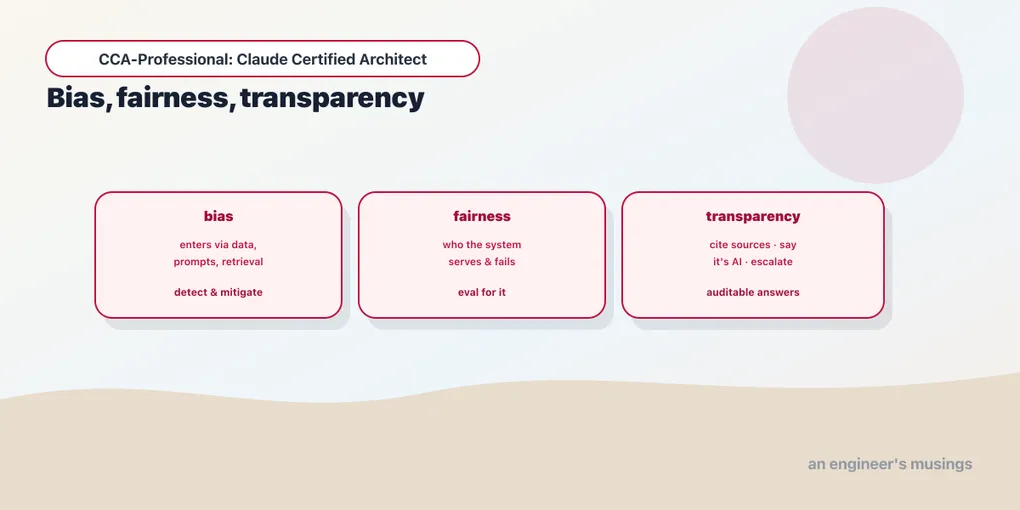
Ethics is the part of governance that people either wave away as PR or inflate into philosophy, and both readings fail an architect. The useful framing is narrower and more demanding: bias, fairness, and transparency are design concerns with concrete decisions attached, the same as latency or cost. A biased system harms real customers, erodes trust, and creates legal and reputational exposure the business will absolutely feel. So this chapter treats ethics the way the exam does, as engineering. Where do these problems enter a Claude system? What can you actually do about them, and what can’t you? As with the last two chapters, this is architecture judgment. Where a recommendation is a design call rather than a run result, the text says so.
Where bias enters a Claude system
“Bias” in an AI system means outcomes that are systematically worse, or systematically different in a way that matters, for some group of the people the system serves. It’s not an abstract property of the model in isolation; it’s a property of your system on your users. It enters at three specific points you can name and inspect.
- The model. A language model learned patterns from a vast training corpus, and that corpus carries the associations and skews of the text it was built from. The model can reflect those, producing responses that treat similar requests differently based on names, dialect, phrasing, or implied demographics. You don’t control this layer’s training, but you’re accountable for its behavior in your system. So you have to assume it exists and design to catch it.
- The prompts. Your own instructions can introduce bias. A system prompt that encodes an assumption about who the “typical” customer is, examples that all skew one way, or a persona that carries a slant will steer every response. This is the layer you most directly control, and therefore the one you’re most responsible for.
- Retrieval. In a RAG system, bias enters through what gets retrieved. If your corpus over-represents some cases and under-represents others, or your retrieval consistently surfaces certain sources, the model’s grounded answers inherit that imbalance. A corpus is not neutral just because it’s “the documents we have,” and retrieval quietly decides whose information the customer receives.
Naming three entry points makes bias auditable. You can inspect prompts, sample retrieval results, and test model outputs across varied inputs. Bias you can’t locate is bias you can’t fix, and “the AI is biased” with no entry point named is a slogan, not a finding.
What fairness means here
Fairness is the flip side of bias. Be concrete rather than aspirational: fairness means the system serves the range of people who use it comparably well. The quality of help a customer gets shouldn’t depend on their name, their dialect, how they phrase a question, or what group they belong to. On the bookshop platform that’s a direct product concern. A support assistant that resolves issues crisply for one phrasing and gets confused or dismissive with another is delivering an unequal product. The customers on the wrong side of that gap get a worse experience for a reason that has nothing to do with their actual request.
The honest part: fairness is not a single number you can maximize, and different notions of it can conflict. What an architect can do is decide which comparisons matter for this system and its users, then measure across them. You define the groups and inputs you care about serving equally, and you check whether you do. That decision — who the system must serve comparably — is design judgment, and it belongs to you and your stakeholders, not to a default.
What transparency owes the user
Transparency is the most actionable of the three, because it’s mostly a set of decisions about what you tell people. Three obligations cover the ground:
- Disclose that it’s AI. Users interacting with the assistant should know they’re talking to an AI, not a human agent. This is a basic honesty requirement and increasingly an expected one. A system that lets users believe a bot is a person has a trust problem waiting to detonate.
- Explain decisions. When the system takes a consequential action or reaches a conclusion, a user (and an auditor) should be able to understand why. Why was this refund denied, why was this the answer. You don’t owe a token-by-token account of the model’s internals, but you owe a legible reason. That’s a strong argument for architectures whose decisions rest on inspectable inputs rather than a single opaque generation.
- Cite sources. When the assistant answers from retrieved material, it should say what it drew on. Citation turns an assertion into a checkable claim. It’s the mechanism that makes a RAG answer auditable: a reviewer, a customer, or an eval can trace the answer back to the source it came from.
Transparency isn’t only a courtesy to users. It’s what makes the rest of governance possible. A system whose decisions and sources are visible is a system you can review, debug, and hold to account.
Why it matters: trust, harm, and risk
Three reasons carry weight with the people who fund the system, and an architect should be able to state all three. Trust: users who can see that the system is honest about being AI, that its answers cite sources, and that it treats people evenly will rely on it. Reliance is the entire point of building it. Harm: a biased or opaque system does real damage to the specific people it treats worse, and that harm is the ethical core, not a side effect. Legal and reputational risk: unfair or non-transparent AI is increasingly a compliance exposure and reliably a reputational one. A single visible failure can cost more than the system was ever worth. These aren’t competing framings of the same concern; they’re three independent reasons that each, on its own, justifies the design work.
The honest limit, and what you design instead
Here is the part that separates a credible architect from a naive one: you cannot fully eliminate bias. The model carries skews you don’t control, fairness has definitions that genuinely conflict, and no amount of prompting produces a provably neutral system. Anyone selling you “unbiased AI” is selling you something that doesn’t exist. The exam knows it, which is why the answer that claims a technique removes bias is usually the trap.
What you can do is design to detect and mitigate, continuously, and that reframes the whole problem from a promise into a practice:
- Evaluate for fairness. The same evaluation discipline the book uses for quality applies to fairness. Build eval sets that vary the inputs you care about — names, dialects, phrasings, implied demographics — and measure whether response quality holds across them. A fairness eval that shows a gap is not a failure of the program; it’s the program working. A gap you can see is a gap you can close. Bias you don’t measure is bias you’re simply choosing not to know about.
- Cite sources. Grounding every answer in retrieved, cited sources both improves quality and makes answers auditable. Bias in what the system claims becomes traceable to a source rather than buried in an opaque generation.
- Keep humans in the loop where stakes are high. The approval gates from the guardrails chapter are a fairness control too. A human reviewing consequential decisions is a check against a systematically skewed one, placed exactly where an unfair outcome would hurt most.
The shape of the answer is always mitigation plus measurement, never elimination. You reduce bias where you can, you measure what remains, you make decisions auditable, and you put a human at the highest-stakes points. That’s not a weaker position than “we solved it.” It’s the only honest one, and it’s the one that actually holds up.
The platform, designed to be accountable
On the bookshop assistant the ethical design decisions are the same ones that make the system good. Every answer cites the policy or article it retrieved, so a customer or a reviewer can check the source and a skewed claim is traceable rather than hidden. The assistant discloses that it’s an AI. When it’s uncertain — a question outside its corpus, an ambiguous request, a low-confidence retrieval — it escalates to a human instead of confidently guessing. A confident wrong answer is exactly how an unfair or hallucinated outcome reaches a customer unchallenged. And a fairness eval runs across varied customer phrasings, so a quality gap surfaces as a measured number a team can act on. It doesn’t become a slow accumulation of worse experiences for the customers least able to complain. None of this claims a bias-free system. It builds a system that is honest, auditable, and watched, which is what an architect can actually deliver.
What the exam is really testing
The ethics items reward the same honesty this chapter does. When an item asks how to reduce bias, the right answers are detect-and-mitigate moves: fairness evals, source citation, human review. The trap is any option promising to eliminate it, because that overclaims. When an item is about transparency, expect disclosure, explainability, and citation to be the levers. And when a scenario describes an uncertain or high-stakes decision, escalation to a human is the fairness-and-safety answer, not a confident automated one. Carry the frame: bias enters at model, prompt, and retrieval; fairness means serving your users comparably and is something you measure; and transparency is what makes the whole system auditable. Hold that, and the ethics domain becomes concrete engineering rather than a values quiz.
Next: discovery and communicating tradeoffs — turning a vague stakeholder ask into a scoped design, and defending the tradeoffs to the people who pay for the system.
Comments