System Prompts and Guardrails at Scale
What a system prompt actually does — role, rules, output contract, and the trusted instruction layer — the prompt techniques an architect leans on and when each earns its place, templating a prompt for reuse across a system, and the line between a prompt-level 'don't' and an enforceable guardrail.
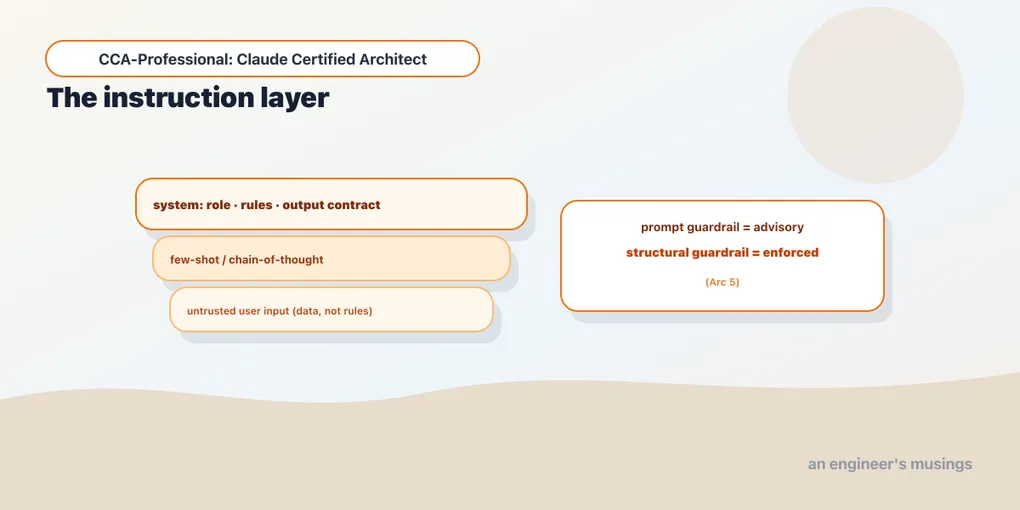
Every Claude call in your system carries a system prompt, whether you wrote one deliberately or let it default to nothing. A few hundred well-chosen words set the assistant’s role, its rules, and the shape of its output for every request that follows. Get it right and a thousand downstream calls behave. Get it vague and you spend the rest of the project patching symptoms. Design that text as an architect designs anything reusable: a component with a contract, not a paragraph you tweak until a demo passes.
This chapter walks through what a system prompt does and the prompting techniques worth reaching for. It ends on the two things the Professional exam presses hardest: templating a prompt for reuse across many call sites, and the hard line between a prompt-level instruction and an enforceable guardrail.
What a system prompt is doing
A system prompt is not “the instructions.” It is doing four distinct jobs at once, and naming them separately is what lets you write a good one:
- Role. Who the assistant is and what it is for. “You are the bookshop’s customer support assistant” scopes every later decision. A model with a clear role declines out-of-scope requests more gracefully and stays in character under pressure.
- Rules. The constraints that hold across all requests: what it may do, what it must refuse, the tone, the boundaries. “Never promise a delivery date,” “ground every recommendation in the retrieved catalogue,” “escalate legal threats to a human.”
- Output contract. The shape the response must take so downstream code can consume it — a JSON schema, a fixed set of fields, “answer in at most three sentences.” An output contract is the interface between the model and the rest of your system, and treating it as an interface is half of making a system reliable.
- The trusted instruction layer. The system prompt is the authoritative channel: the model weights instructions there above anything that arrives later in a user turn or a tool result. That trust is exactly why what you put in the system prompt matters. It is also why untrusted content must never be allowed to become system-prompt authority — not a customer’s message, not a retrieved document, not a tool’s output. Keeping that boundary intact is the root of prompt-injection defense.
Hold those four jobs in mind and a weak prompt becomes diagnosable: it usually has a role but no output contract, or rules stated so vaguely the model reads them as suggestions.
Why it matters, and when a prompt is the wrong fix
The system prompt earns its leverage because it applies once and affects everything. That is also its trap. Because a prompt edit is cheap and instant, it is tempting to answer every misbehavior with more prompt — another “IMPORTANT: you MUST” line, another caveat, another example. Past a point this backfires. The prompt bloats, the rules start to conflict, and a modern model reading a wall of aggressive imperatives over-triggers on some and skims others.
The architect’s judgment is knowing when a prompt is the right instrument and when it is not. A prompt is the right fix for behavior, tone, format, and scope. It is the wrong fix for anything that must be guaranteed rather than encouraged. When you find yourself writing a prompt rule to prevent a catastrophe, that is the signal you need a structural control, not a stronger sentence.
The techniques an architect leans on
Three prompting techniques cover most of what a system needs, and the skill is matching each to the job rather than defaulting to one.
Zero-shot is a plain instruction with no examples: “Classify this message as billing, shipping, or product.” It is the right default when the task is common and the instruction is unambiguous. Most well-scoped tasks want nothing more, and reaching for anything heavier is wasted tokens.
Few-shot adds a handful of worked examples to the prompt. It is the tool for format and edge cases — when the output shape is specific, or the task has conventions an instruction alone conveys poorly. This is not folklore; it is measured. The Foundations track’s precision chapter ran the same extraction task with and without examples. Format adherence went from 0 of 4 to 4 of 4 once a few examples showed the exact shape wanted. When a model keeps getting the content right and the format wrong, few-shot is the lever, and it usually beats another paragraph of description.
Chain-of-thought asks the model to reason step by step before answering. It helps on genuinely multi-step problems where the reasoning is the work — the refund judgment, or a policy that composes several conditions. It costs latency and output tokens, and it is overkill for a lookup. On current models an explicit “think step by step” is often unnecessary, because a thinking mode does the same job more cleanly. The architectural point stands either way: spend reasoning where the task is hard, and not where it isn’t. Zero-shot for the easy majority, few-shot to pin format, reasoning for the hard minority — the same escalate-only-when-needed instinct as model routing.
Templating for reuse across a system
Here is where prompt writing becomes system design. A platform does not have one system prompt; it has many call sites: the retrieval-answer step, the refund-reasoning step, the router. They share a great deal — the same role, the same tone, the same PII rules, the same escalation policy. Copy-pasting a prompt into each call site is the same mistake as copy-pasting a function. The moment the escalation rule changes, you are editing it in six places and missing the seventh.
The fix is a prompt template: a stable base of shared role and rules, with the task-specific instructions and any per-request variables slotted in. One source of truth for “who the assistant is and what it must never do,” specialized per step. This buys the ordinary benefits of any shared component: change the PII rule once and every call site inherits it. It also buys one benefit specific to this platform. A template that keeps its shared prefix byte-stable is a template that caches, which the next chapter turns into real money. Design the template so the large stable part comes first and the variable part comes last, and reuse and caching fall out of the same structure.
Prompt-level guardrails versus structural ones
There is a limit here, and it is the most important idea in the chapter. A rule in a system prompt is advisory. It shapes probability; it does not enforce. “Never issue a refund over fifty dollars without approval” makes the model much less likely to do so. It does not make it impossible. A cleverly worded customer message, an unexpected edge case, or simple model error can still produce the forbidden action. The prompt is guidance the model usually follows, not a gate the request must pass through.
So the architect draws a line:
- Prompt-level guardrails — role, rules, tone, refusals expressed as instructions — are the first and cheapest layer. They handle the broad majority and set the assistant’s default behavior. Keep them, and keep them clear.
- Structural guardrails are enforced in code, outside the model’s discretion: an approval gate that refuses to execute a refund over the threshold no matter what the model decided, an allowlist on what a tool may touch, a validator that rejects any output failing the schema, an independent classifier that blocks a response before it reaches the customer. These do not depend on the model choosing correctly. They are the subject of this book’s Arc 5. It is a whole arc because the enforceable guarantees a governed system needs cannot live in a prompt.
The test is simple: if a wrong answer is merely embarrassing, a prompt rule is enough; if a wrong answer is a breach, a refund you can’t claw back, or a compliance violation, the control must be structural. An exam scenario that protects an irreversible or regulated action with a system-prompt “don’t” and nothing else has an unenforced guardrail. It is the same fail-open shape you will meet again in every governance chapter.
The bookshop support assistant’s prompt
Applied to our platform, the design has clear layers. The shared template base sets four things. The role is the bookshop support assistant. The standing rules ground recommendations in the retrieved catalogue, never promise dates or unauthorized discounts, and handle PII under least privilege without ever echoing a full record. The tone is warm, concise, professional. The escalation policy hands chargebacks, legal threats, and safety concerns to a human. Each step then specializes it. The retrieval-answer step adds a zero-shot instruction to answer only from provided context and say so when the answer isn’t there. The refund step adds reasoning over the eligibility rules. The router adds a tight few-shot set pinning its label format.
And the refund threshold lives in two places on purpose. The prompt states it, so the model reasons correctly almost always. The approval gate in code enforces it, so the one time the model is talked past the rule, the money still does not move. That is the whole chapter in one design: the prompt makes good behavior likely, and the structure makes bad behavior impossible.
Final thoughts
A system prompt does four jobs: role, rules, output contract, and the trusted instruction layer. Designing it means treating each as a deliberate choice rather than one blob of text. Reach for the technique that fits: zero-shot for well-scoped tasks, few-shot to pin format (0 of 4 to 4 of 4 when examples showed the shape), reasoning only where the task is genuinely hard. Template the shared role and rules so one edit reaches every call site, and order the template so it caches. Above all, hold the line between advisory and enforceable. A prompt rule shapes behavior, a structural guardrail guarantees it, and anything irreversible or regulated needs the second kind. Write the prompt to make good behavior likely, and build the structure that makes the costly failure impossible.
Next: context, caching, and prompt reuse — managing the context budget and the three levers that let a large, stable prompt pay for itself instead of billing full price on every turn.
Comments